
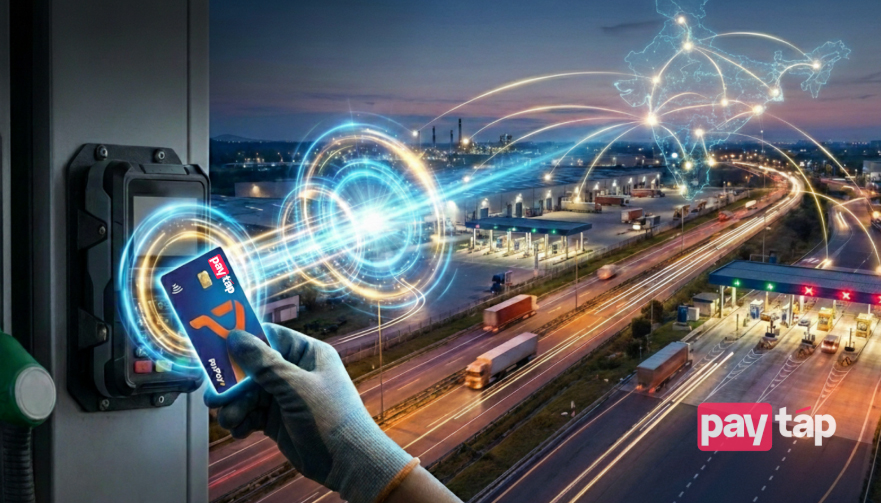
RuPay-powered contactless payments, built for businesses in motion
Bengaluru, (Karnataka) [India], January 21, 2026: For years, India’s digital payments story has been told through the lens of convenience: scan, pay, move on. But across highways, warehouses, and supply corridors,everyday business spending still depends on approval calls, transfer requests, and end-of-day reconciliation creating friction for teams that operate in motion.
At fuel pumps before dawn, during fastag toll recharges between deliveries, and at roadside workshops that keep operations moving, owners are discovering a new capability: the ability to send money into the field with rules, limits, and accountability built in from the start.
This is the layer Bengaluru-based fintech PayTap is building, turning RuPay-powered contactless tags and prepaid card instruments into the operating system for payment control in field-driven businesses.
The Moment Contactless Becomes a Business Tool
Visa’s India Consumer Payment Attitudes Study and Global Contactless Reports position India as one of the fastest-growing contactless payment markets in the Asia-Pacific region, with tap-to-pay adoption accelerating across fuel stations, transit corridors, and everyday in-person commerce.
While contactless was originally built for urban transit, retail counters, and consumer convenience, PayTap is pushing this infrastructure into the operational core of the economy: logistics yards, small fleet operations, and field-based businesses.
For owners managing five vehicles or fifty, the challenge has never been about making a payment. It’s about governing hundreds of on-the-move decisions made by drivers and field teams every day.
When contactless is paired with vehicle-level business rules and backed by prepaid infrastructure for both in-person and online spending, it becomes more than fast. It removes reliance on cash handovers, personal cards, and UPI screenshots—and turns spending into a structured, controlled system.
RuPay at the Core, Business Context on Top
PayTap operates on India’s domestic card network, issuing RuPay-powered prepaid cards and NFC-based contactless tags through partnerships with RBI-authorized regulated issuing institutions and network participants.
But the real innovation sits above the rails.
Each card or tag is not just linked to a person. It is mapped to a business asset—a role or an operating unit—under the company’s or owner KYC.
For the owner, this means:
- Funds are assigned before deployment, not reimbursed after spending
- Policies are enforced at the tap, not during audits
- Every transaction is automatically labeled with operational context
A field payment is no longer just a debit. It becomes a data point tied to a specific role, route, and operating unit.
Designed for India’s Real Operating Environment
Across assessments from the Ministry of Road Transport & Highways (MoRTH), industry research firms, and transport associations, one reality stands out: most of India’s transport operators manage fleets of fewer than 5–10 vehicles.
In these businesses, finance teams are rare. Decisions happen on the road.
PayTap’s contactless tags are built for this reality. They work on RuPay-certified, acquiring bank–approved POS terminals using EMV-based standards—terminals already present at fuel stations, toll points, and service merchants across the country.
Owners can define simple, practical rules:
- Spending limits per role or operating unit
- Category controls for fuel, tolls, service, or supplies
- PIN-based checks for higher-value transactions
The result is a system that moves as fast as cash, but behaves like a financial policy engine.
From Taps to Transparency
Every contactless transaction on PayTap generates a clean, structured record—merchant details, terminal IDs, time, and location—without adding work for drivers or staff.
Over weeks and months, this stream of data begins to change how small businesses operate:
- Reconciliation shifts from chasing receipts to reviewing dashboards
- GST alignment becomes clearer
- Financial histories become verifiable
What starts as a payment method becomes a financial footprint—one that owners can use with banks, partners, and formal institutions.
Enabling India’s Next Payments Layer
Globally, contactless networks have reshaped how cities move.
In India, they are beginning to reshape how businesses govern money in motion.
By combining RuPay’s domestic payment rails, NFC-based hardware, and a business control platform, PayTap is helping extend India’s digital payments ecosystem into places where informal and unstructured payment practices have traditionally dominated—without breaking the speed and simplicity operators depend on.
Not just enabling a tap.
But enabling trust, structure, and scale for the people and businesses behind every route, delivery, and decision in motion.
About PayTap
PayTap is a product of Drivetap Innovation India Private Limited, a Bengaluru-based fintech building India’s contactless business payments infrastructure for logistics, mobility, and field-driven industries. Founded by Akshay Neelakantha and co-founded by Uday Shankar Mishra, PayTap partners with issuing banks, acquiring networks, and merchant ecosystems to extend regulated, tap-and-go payments into the heart of on-ground operations. Through RuPay-powered prepaid cards, NFC contactless tags, and a centralized control and expense platform, PayTap enables businesses to move from cash-dependent workflows to policy-driven,transparent, controlled, and scalable financial systems.