

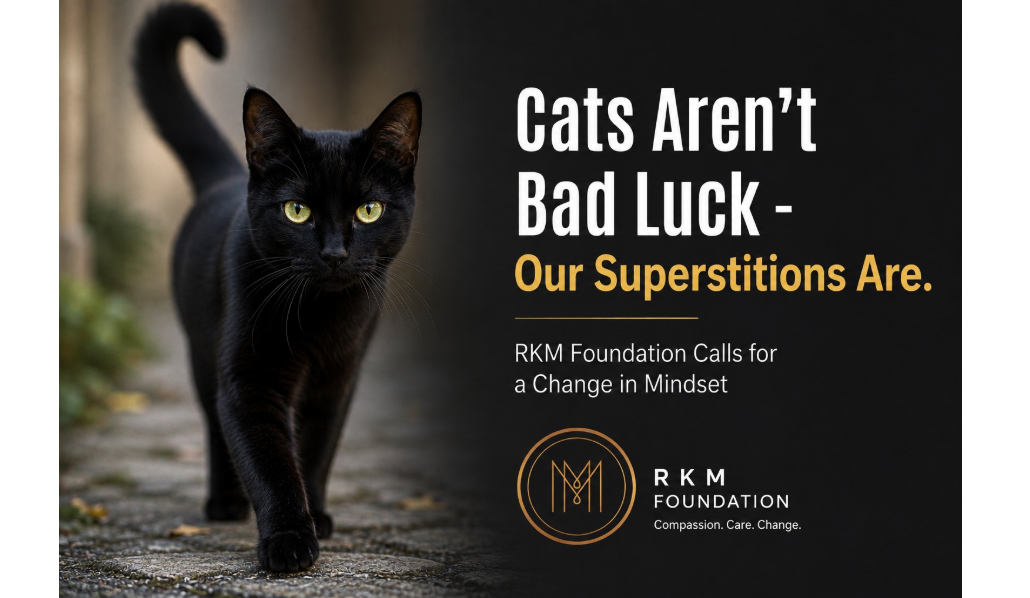
For centuries, a cat crossing one’s path has been considered a sign of bad luck. Across cultures and generations, this belief has become one India’s most enduring superstitions, influencing how people perceive an animal that has done nothing wrong. Yet the reputation attached to cats especially a black cat is rooted not in fact, but in centuries of folklore, myths, and stories that gradually linked them with mystery, witchcraft, and misfortune. The question is simple: what did the cat do to deserve such a legacy?
History, in fact, presents a very different picture. In Ancient Egypt, cats were revered and protected. Scottish folklore viewed the arrival of a black cat as a sign of prosperity, while Japanese traditions often associate cats with good fortune and protection. Sailors once welcomed black cats aboard ships, believing they would bring safe journeys and calm seas. These examples suggest that the meaning attached to cats has always depended more on human interpretation than on the animals themselves.
Interestingly, some cultures viewed a cat crossing one’s path not as a warning of bad luck, but as a reminder to pause. Modern science tells us that cats are highly sensitive observers of their surroundings, constantly responding to sounds, scents, vibrations, and movements that humans often fail to notice. While there is no scientific evidence that cats can predict accidents or alter fate, there is strong evidence that mindfulness and awareness help people make better decisions and avoid mistakes. In that sense, a cat crossing our path may simply encourage us to slow down, become more attentive, and break the rhythm of routine for a few moments.
Anyone who has spent time with a cat quickly realizes how disconnected the myths are from reality. Like any other pet, they seek affection, become attached to people, play, feel fear, and express comfort through simple gestures such as purring. They are not omens or symbols; they are living beings with unique personalities and emotions. Unfortunately, the persistence of old superstitions continues to have real-world consequences. Animal welfare organisations around the world report that cats are often overlooked for adoption especially black cats and spend longer periods waiting for homes compared to lighter-coloured cats.
At RKM Foundation, these stories are all too familiar. Operating an animal shelter in Pali, Maharashtra, the organisation rescues and cares for abandoned, injured, neglected, and forgotten animals, including dogs, cats, cows, and other species. Every day, the team witnesses animals once considered unwanted transform into beloved companions after receiving proper care, treatment, and affection. These experiences reinforce a simple truth: assumptions often prevent people from seeing the value and beauty that already exist before them.
Perhaps that is the lesson cats have been teaching us all along. Fear often survives not because it is true, but because it is familiar. Compassion begins when we question old beliefs and choose kindness over superstition. The next time a cat crosses your path, RKM Foundation encourages people to see it not as a sign of bad luck, but as a reminder to pause, smile, and remember that every animal, regardless of its colour, deserves love, respect, and a chance at a better life.